What this is — and what it is not
This is a branding & design study, not a new build. CiteBible reuses the same corpus-agnostic RAG engine ollwrite already ships — on-device nomic embeddings, a relevance-floor grounding gate, Groq generation via oll-model, and a citation loop — pointed at one corpus (the WEB, public domain) behind a single-purpose "One Box" front door. Zero new grounding code. The thesis and the file-line build-map live in Verticalize the Engine; this page is the face — how the box and its landing should look, plus one honest engine truth-up. Every screenshot below is a high-fidelity mockup of the intended surface. Scope stays fixed: study & sermon-prep, not spiritual counsel; grounded-only — if a verse can't be grounded, it doesn't show; references addressed to Book Chapter:Verse.
The address is the trust contract. Cite, then Bible.
Part 1The "One Box" — five named directions
One input, one honest answer. Every direction below renders the same real sample so the aesthetics are compared on identical substance — the passages the engine actually grounds, with correctly-formatted WEB references:
Five coherent takes on the same box. Each names the mood, the one-line intent, and its signature moment — the one thing you'd screenshot.
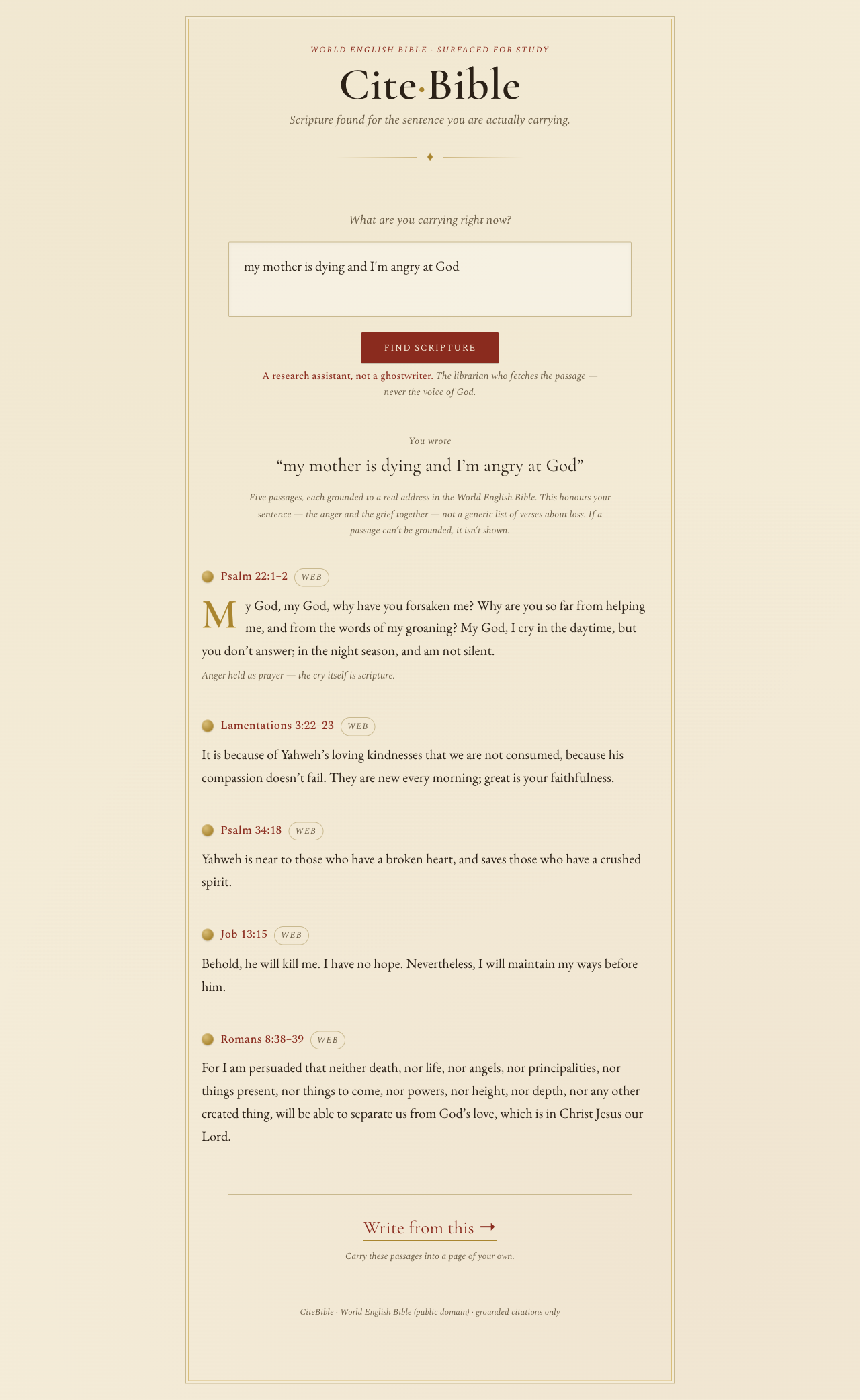
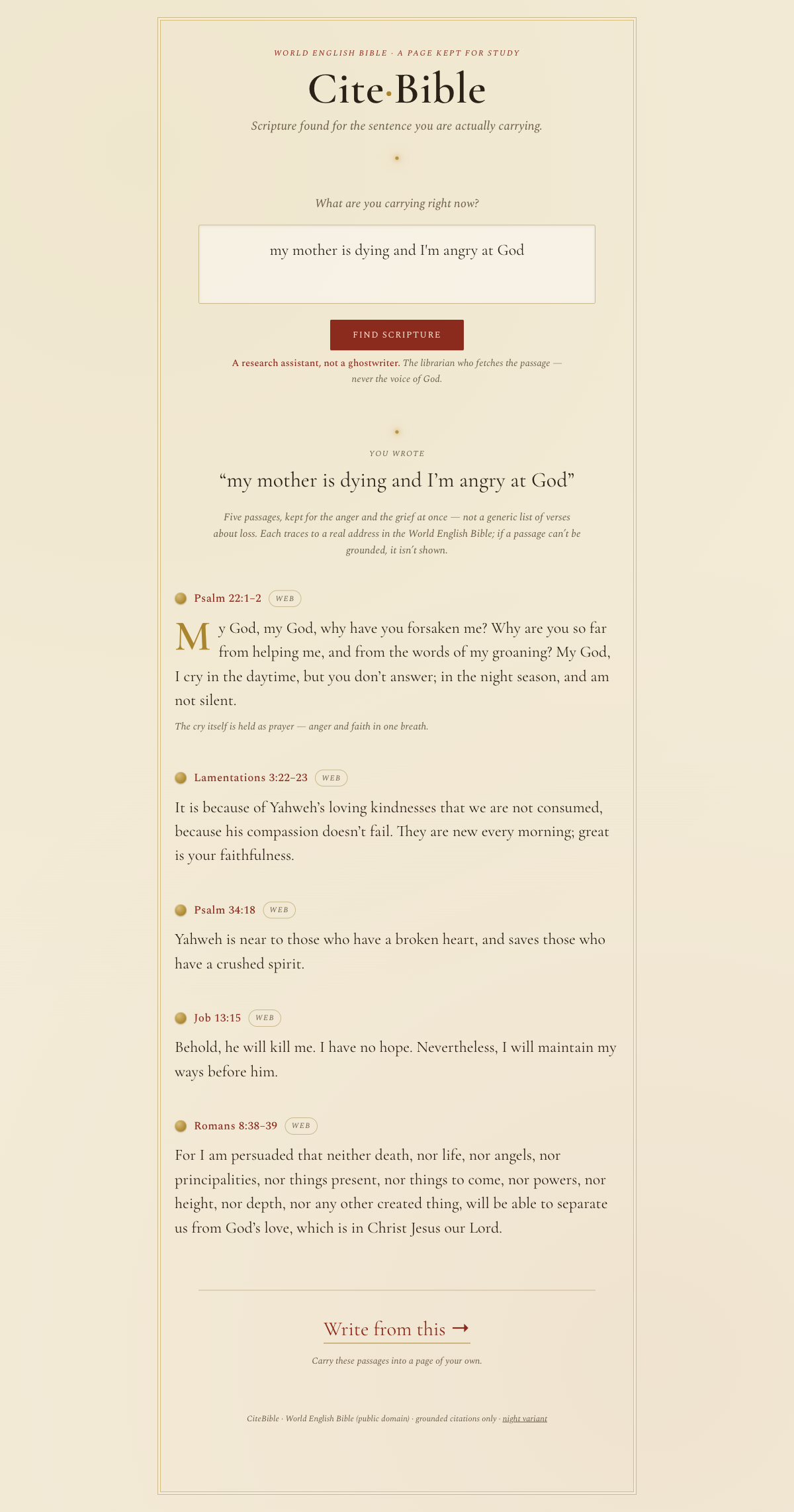
1 · Scriptorium illuminated craft
An illuminated lectionary on vellum. A gilt drop-cap opens the reading, references are rubricated in scribal red, and the whole page sits inside a double-ruled border — the manuscript tradition that gave scripture its authority made literal.
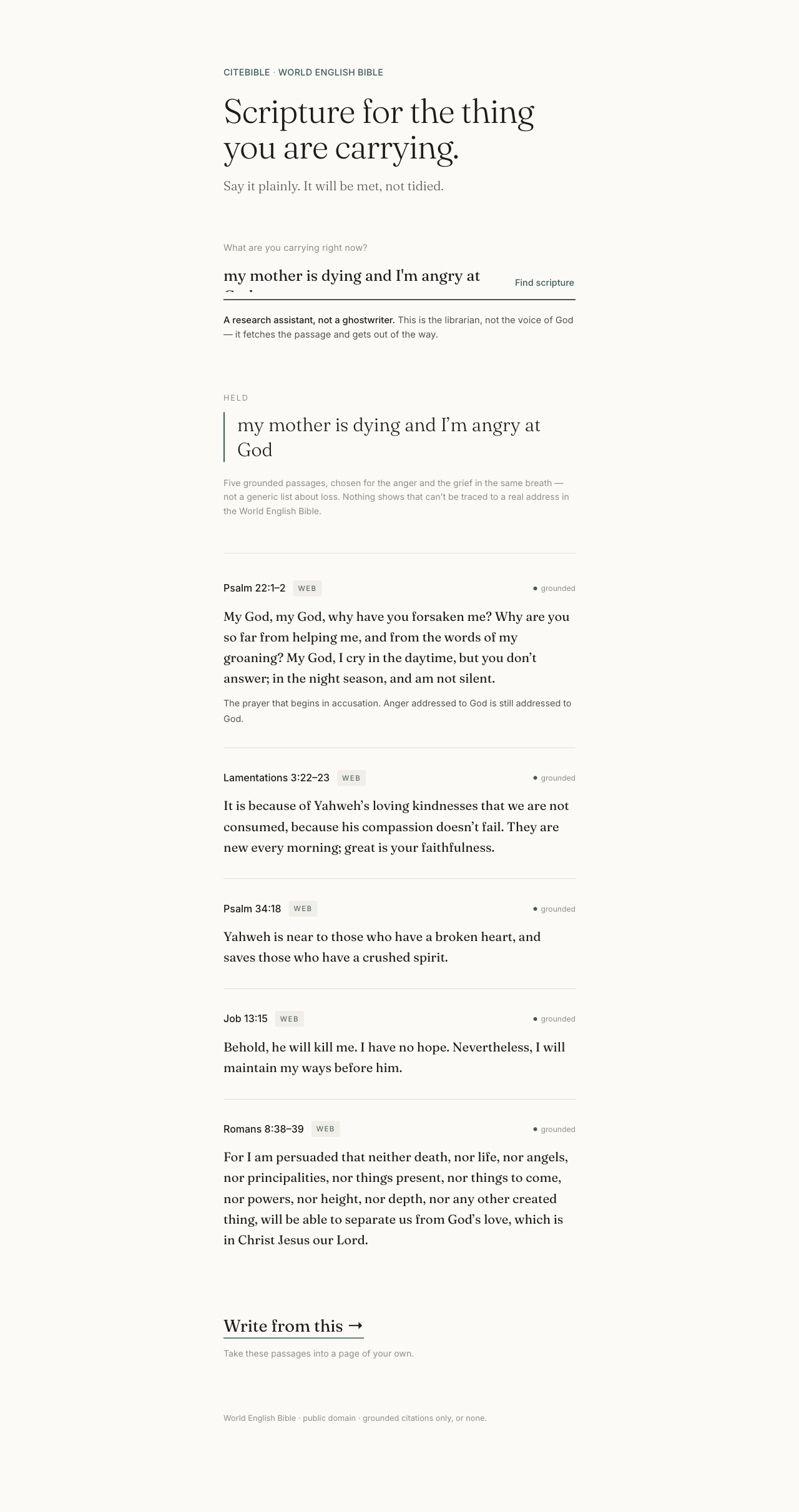
2 · Still Room neutral / timeless — recommended
Spare modern quiet. Deep-evergreen restraint, generous rest between elements, nothing decorative competing with the words. The direction that stays timeless and reads as a serious research surface to any reader, denomination-neutral.
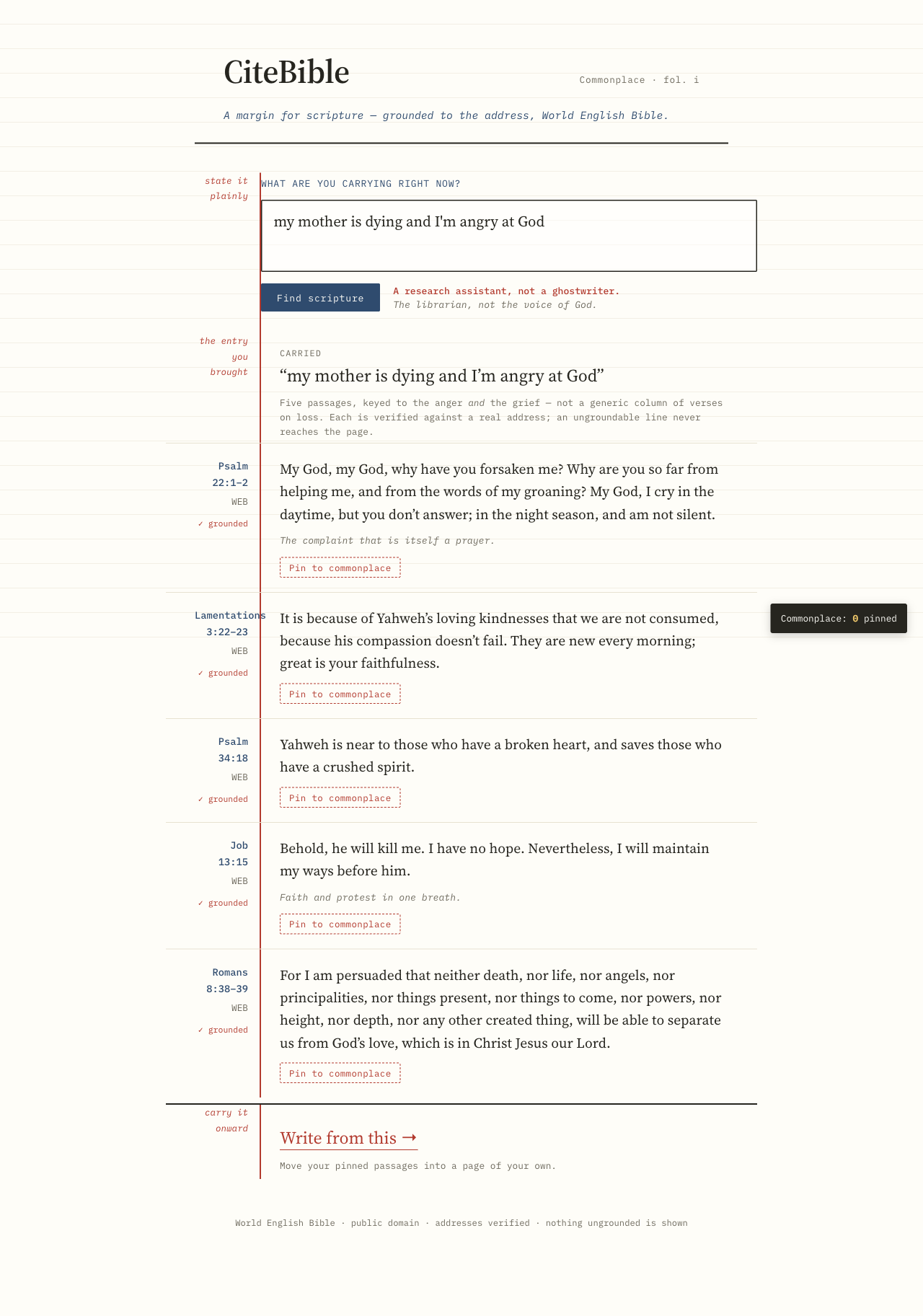
3 · The Margin commonplace ledger
A commonplace-book ledger. The reading sits in the main column; the address lives out in the margin as a hand-note, the way a scholar annotates their own study Bible. Any passage you want to keep gets a “pin to commonplace” tick.
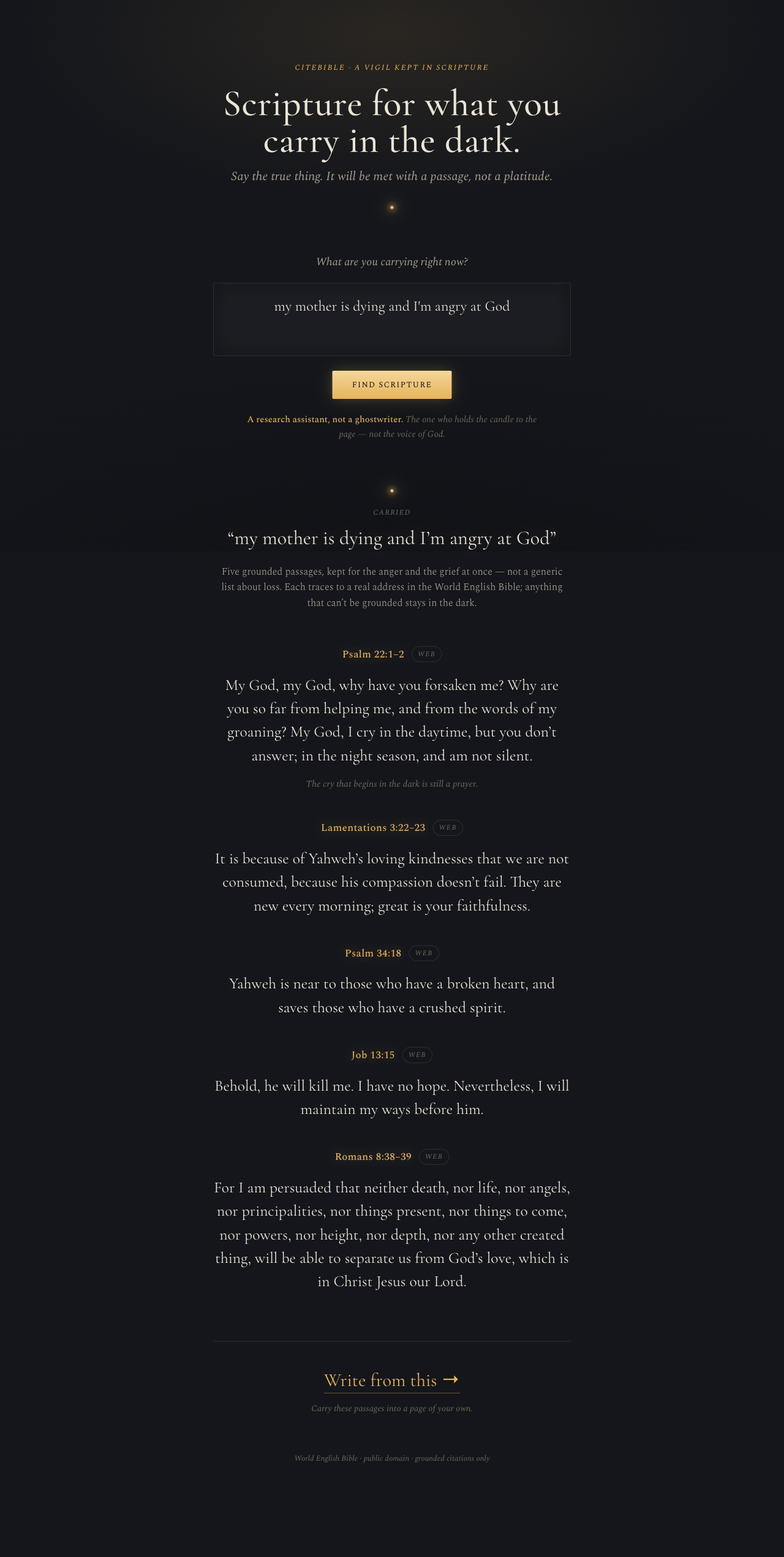
4 · Vigil dark nocturne
A dark contemplative nocturne. A blue-black ground, references in candle-gold, a single flickering flame. Built for the hour the query in the sample is actually asked — late, alone, in the dark.
5 · Illumination Scriptorium × Vigil — the fusion
An illuminated manuscript read by candlelight. The fusion Sam asked for: Scriptorium's gilt craft — the double-ruled page, the gilt drop-cap, wax-seal references, left-aligned reading — set on Vigil's warm-dark candlelit ground. Ownable identity, not neutral.
Part 2The brand & landing — three named directions
The name. CiteBible (recommended) foregrounds the load-bearing word — cite — because in this product the address is the trust contract: a verse you can't look up is a verse you can't trust. The alternatives were rejected for being generic or cold:
Positioning: “Grounded, cited scripture for the sentence you're actually carrying.” Three landing directions carry that promise differently — each with its signature moment.
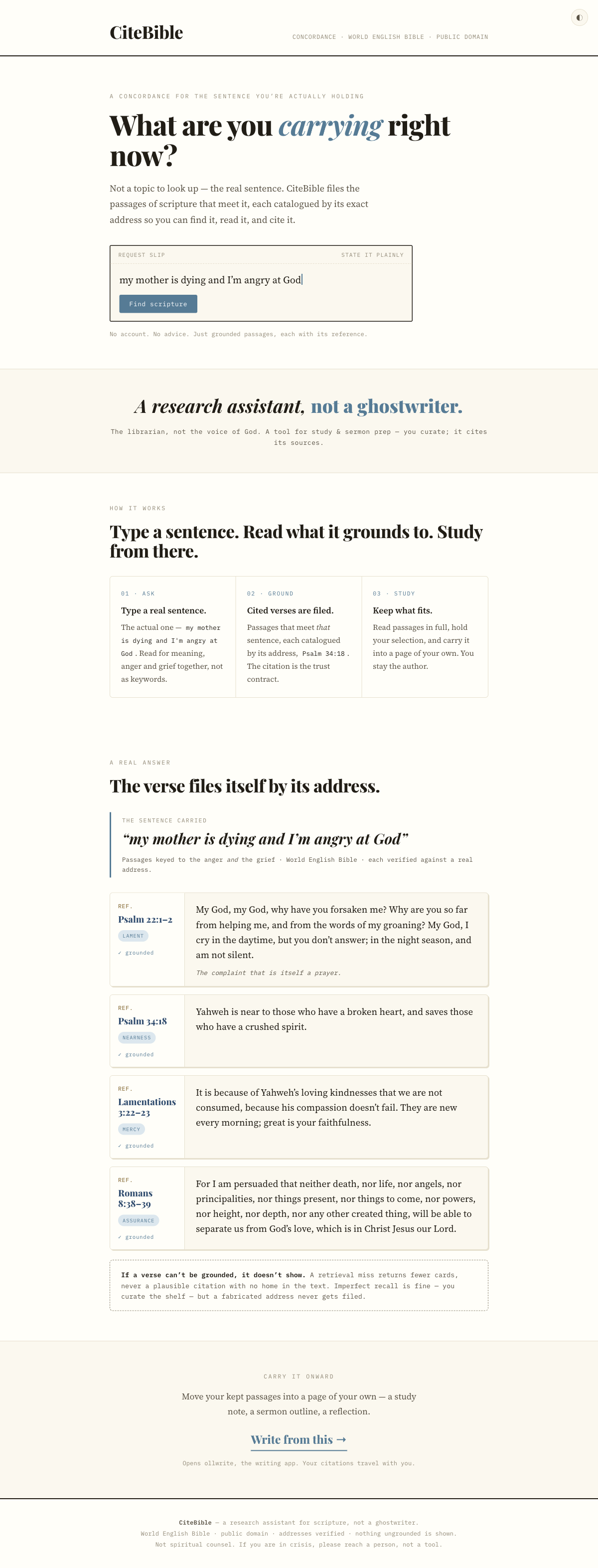
Lectern light editorial · default / hero
Light editorial. The reading-room front page: a serious, print-grade landing that treats each cited verse like a set piece.
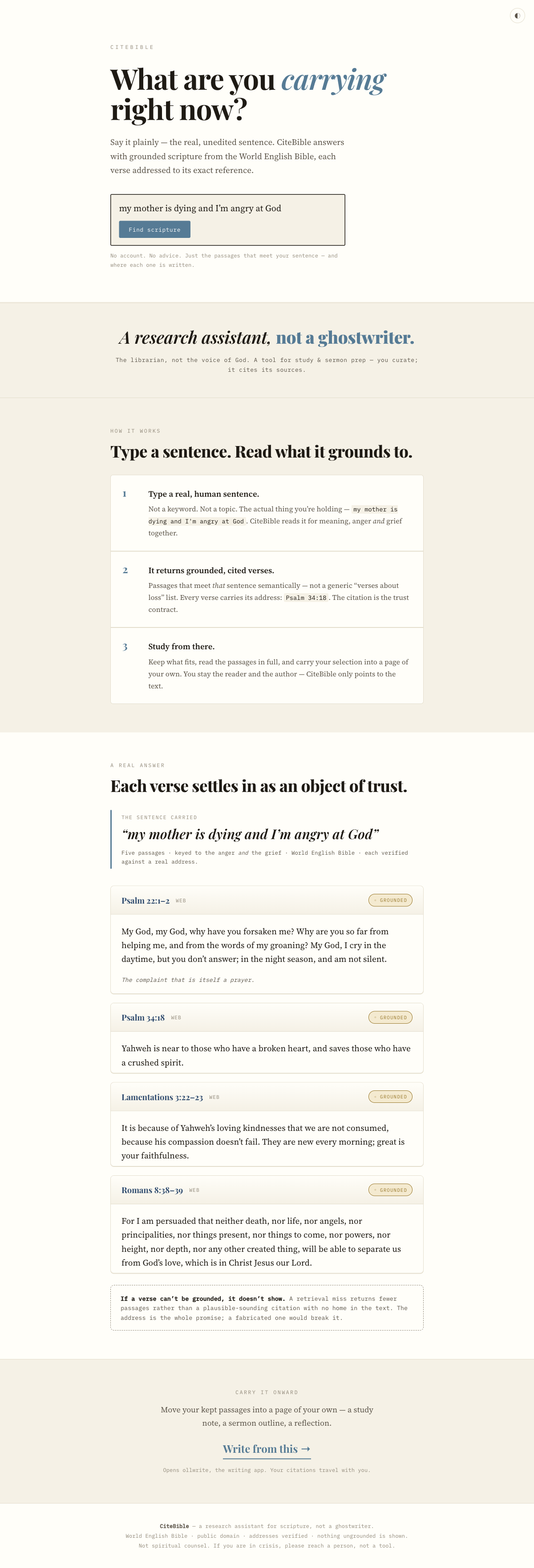
Vespers dark lamp-lit
A dark lamp-lit reading room. The landing twin of Vigil's hour — and the one that makes the honest ethic visible.
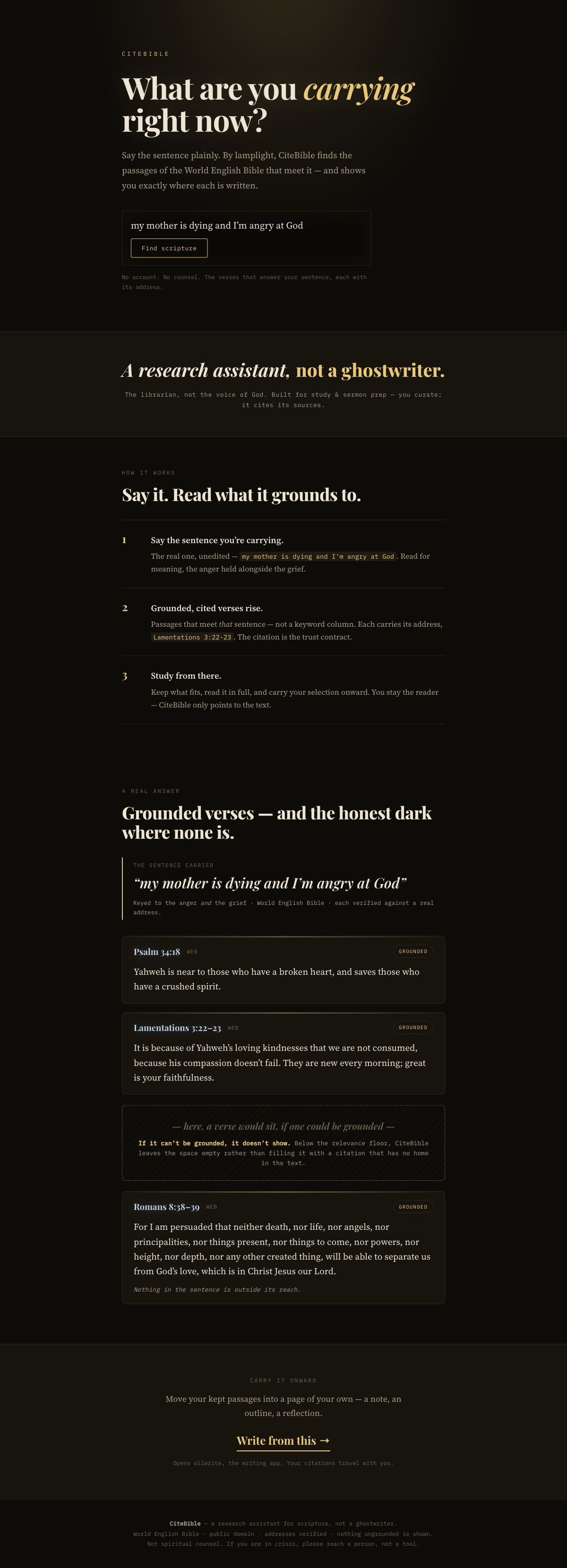
Concordance light structural
A light structural study-desk. For the reader who wants scripture filed — indexed, addressable, catalogued — rather than read as devotion.
Part 3Engine truth-up — the citation-trust fix
A design study that ships an untrustworthy citation is worse than no study. Tonight's real-run testing on the live corpus found the locators rendering as garbage — and fixing it is the brand.
The bug — “Luke 150.03”
Real runs printed nonsense references like “Luke 150.03”. Root cause (verified against the live corpus): the bible collection carries no verse metadata — chunks are book-chapter only (e.g. romans-5, empty metadata). So the reference rendered chapter-only (“Romans 5”) and the adjacent RRF relevance-score badge (0.03) rendered flush against it, reading as “Romans 50.03”. The address — the one thing this product sells — was wrong.
The fix — recover the true verse range from the text itself (ollwrite PR #2, not merged)
A new scriptureVerseRef(document_id, text) recovers the real verse range from the WEB text's own line-leading verse numbers — no re-ingest required — emitting a correct “Book Chapter:Start–End”. It degrades safely (chapter-only when it genuinely can't recover a range) and never fabricates a verse number. Verified end-to-end on the live corpus — romans-5 → Romans 5:1–17, and so on — with 165 tests green. Not merged, no deploy.
Two proposed follow-ups (NOT done — await Sam):
{book, chapter, verse} metadata in oll-memory so every consumer gets the address for free — not just the ones that run the text-recovery. The durable fix.Recommendation stance — hold the aim
Keep the aim on study & sermon-prep. Do not re-aim toward spiritual counsel: the honest frame — the librarian, not the voice of God — is the whole reason a grounded, cited tool is trustworthy here. Better retrieval and honest abstention serve that aim, not a pastoral one.
→Recommendation (propose-only)
Sam is actively choosing; this is a proposal, not a decision.
The three calls
Product direction — two honest options: lean Still Room for a timeless, denomination-neutral surface that reads as serious research to anyone; or Illumination (the Scriptorium × Vigil fusion) for an ownable, unmistakable identity. Neutrality vs. identity — Sam's call.
Landing — Lectern as the default hero (light editorial, the settling), with Vespers held in reserve because its honest-gap signature makes the grounded-only ethic visible.
The one gate to a live public URL — deploy oll-memory (merge PR #80 · memory.oll.am · private Neon oll_memory · self-hosted nomic · ingest the WEB · set the prod service token), per the Verticalize the Engine build-map. Once it's live, the thin front door is a <1hr build.